
The Spirit of the Well
Alongside the footpath that follows the course of Brislington Brook, stands a circular stone structure known as St. Anne’s Well. According to Reverend Ethelbert Horne, “there was no other Somerset well with the historical associations possessed by St. Anne’s Well”, a statement that stills holds true today. The history of St. Anne’s Well is a fascinating fusion of fact and folklore: King Henry VII and Queen Elizabeth of York purportedly visited the site, sailors would frequent the well to pray for a safe voyage, and local people would resort to the water in hope of healing an array of afflictions.
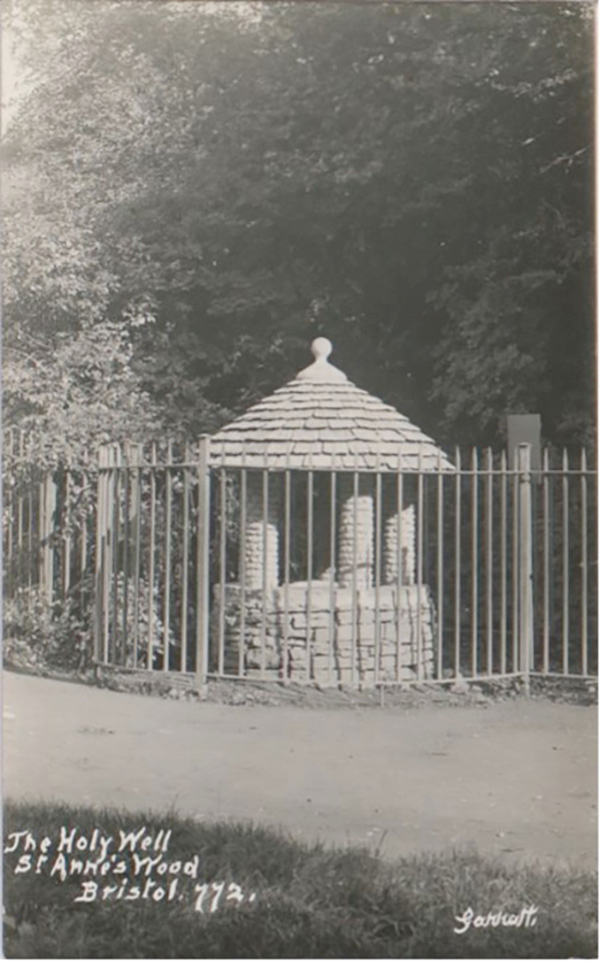
St. Anne’s Well is one of many such holy wells which can be found scattered across the British Isles and beyond. They are widely believed to have ancient provenance and are often deemed to be a vestige of water worship. Following this line of thought, the water bodies were the dwelling places of deities, or sometimes the deities themselves. This water worship is evident throughout time and space, with notable examples including the Hindu belief in Ganga, the personification of the river Ganges, and the Roman’s veneration of Sulis Minerva at Aquae Sulis (or Bath, as it is now known).
A variety of curious customs accompanied this water worship, including sacrifice and divination.The Christian religion spread throughout the British Isles in the early medieval period, and this had an indelible impact on the landscape. Churches and chapels were established, with communities taking root around these spiritual institutions. For practical purposes, these churches and chapels were set up near to natural springs. Often, these were the same springs that had been venerated since ancient times. Christian missionaries would re-consecrate these springs, bestowing them with new names and legends as part of a re-branding exercise to support the spiritual transition from paganism to Christianity. In many cases, these holy wells were supposed to possess curative powers, and pilgrims would travel far and wide to sample the sacred waters.
In the early modern period, holy wells and sacred springs were subject to renewed interest. The Scientific Revolution resulted in new understandings, with the curative powers of the waters now being attributed to their unique chemical compositions. Spa resorts were established to capitalise on the springs, which proved to be popular with tourists attracted by the combination of health and leisure. Examples of such spa resorts include Bath, in Somerset, and Buxton, in Derbyshire. Even in the 21st century, holy wells continue to capture the collective imagination through their symbolic association to the natural world, ultimately inspiring us to reassess our own relationship with the environment, in hope of a better future.
With all this in mind, I encourage the reader to visit St. Anne’s Well, to peer inside the stone structure, and reflect on the significance of this inconspicuous water source. As a gentle breeze blows through the branches that hang from above, listen closely and you might just hear the spirit of the well whisper: “go forth and remember me”.
By Chandon Gallagher